
The Steering Committee reviews the first three years of the project and sets the strategic objectives for 2026–2030 - Life eCOadapt50
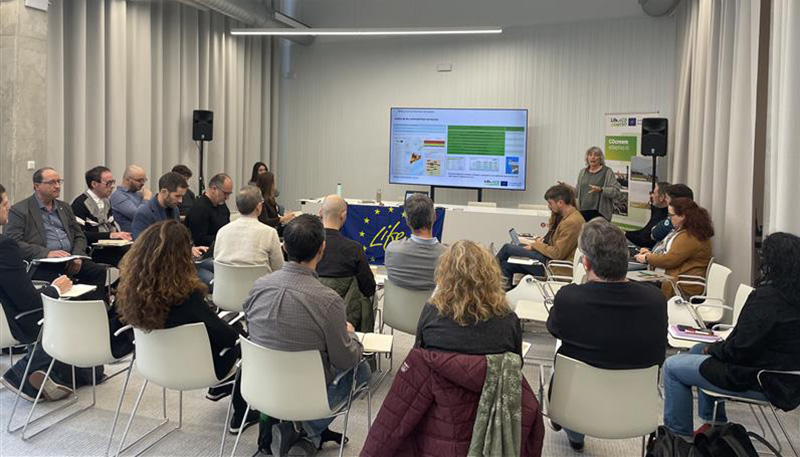
A technical presentation by project director Núria Parpal summarised the work carried out during the first three years, followed by a presentation on budget execution and financial management by project technician Sara Martuscelli.
Highlights included the organisation of 78 living labs with 1,717 participants representing 299 organisations, three joint meetings between partners and various sectoral and territorial stakeholders, and the proposal of 106 climate adaptation actions, 23 of which are completed and 24 ongoing. The territorial vulnerability assessment, which guides discussions in the living labs, was also emphasised, as well as the capacity-building activities, with more than 400 participants in training courses on climate change, 5 webinars and 3 in-person workshops on topics such as forest management, tourism diversification, insurance and risk management, fisheries challenges regarding climate change, and agriculture and adaptation. Dissemination actions and alliances with other projects were also highlighted.
Regarding budget execution, the first phase remained below initial forecasts, although expenditure has increased progressively, with some items doubling in the last year.
Strategic objectives and work plan
After the review, partners discussed the strategic goals for 2026–2030 to make Life eCOadapt50 a benchmark for climate change adaptation in Catalonia. Key topics included strategic action, mobilising funds, and strengthening engagement and training activities.
To guide the discussion, three questions had been shared beforehand. The first was: Beyond current actions, which strategic and structural climate adaptation projects could we develop?
Participants highlighted the need for projects addressing extreme heat, drought, and sustainable land management, especially in rural areas and the agricultural, livestock and forestry sectors. They also emphasised integrated planning aligned with the ESCACC30, multifunctional forest management, adapting regulations, valuing ecosystem services, and developing sectoral strategies (tourism, livestock, regenerative agriculture) to prepare for increasingly extreme climatic events.
Integration of adaptation and mobilisation of funds
The second block focused on the work packages WP7 Integrating adaptation into public and private policies and plans and WP8 Reducing the financial gap for climate adaptation at local level. These strategic work packages will gain relevance from 2026 onwards.
Marc Marí (Girona Provincial Council), leader of WP7, explained that the main objective is to support public and private actors in integrating climate adaptation into their plans, strategies, policies, budgets and investments. Specific goals include supporting local governments, promoting adaptation in private-sector strategies, and providing policy recommendations for higher-tier governments based on lessons learned.
Sara Martuscelli (Barcelona Provincial Council), who leads WP8, presented its key objectives: creating a roadmap for green investments and insurance mechanisms to mobilise adaptation funding, establishing a financial advisory group, and mapping financial resources and support schemes.
Javier Gómez (Arç Cooperativa) presented the strategy for implementing a risk management culture focused on reducing the impacts of climate change on socio‑economic activities within the insurance sector.
Dialogue with partners
The second guiding question was: In which key policies, plans or instruments would it be most strategic to integrate climate adaptation?
Participants stressed integrating adaptation into existing policies through interpretative guidelines, improving hydrological, forest and coastal planning, and reinforcing tools such as climate credits and emission compensation programmes. They highlighted aligning studies and interventions with the most vulnerable areas, integrating trade union perspectives on climate-related occupational risks, and promoting spaces for debate such as a congress on extreme heat.
The final question was: How can this project help generate financial mechanisms that ensure sustainability and scalability of the adaptation actions promoted by LIFE eCOadapt50?
Suggestions included connecting the project with existing climate finance mechanisms (Climate Fund, Pro Acció Green, extensive livestock support, climate credits, ICF funding lines, ICAEN programmes), developing tools such as the cost of Non‑adaptation, and improving coordination among the four provincial councils and the Catalan Government to maximise impact and facilitate funding access. The need to promote joint initiatives and strengthen the complementary role of each institution was also highlighted.
The debate was intense and rich in contributions. Participants emphasised the importance of prioritising strategic lines in order to scale up the project and position Life eCOadapt50 as a benchmark for climate adaptation in Catalonia.