
A pilot test by GALP Costa Brava in Roses and Palamós trials portable desalination units on fishing vessels - Life eCOadapt50
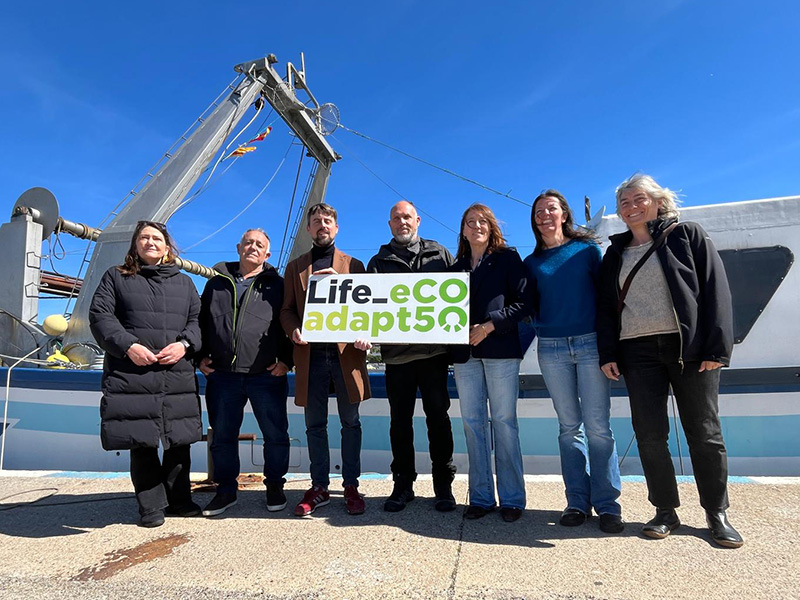
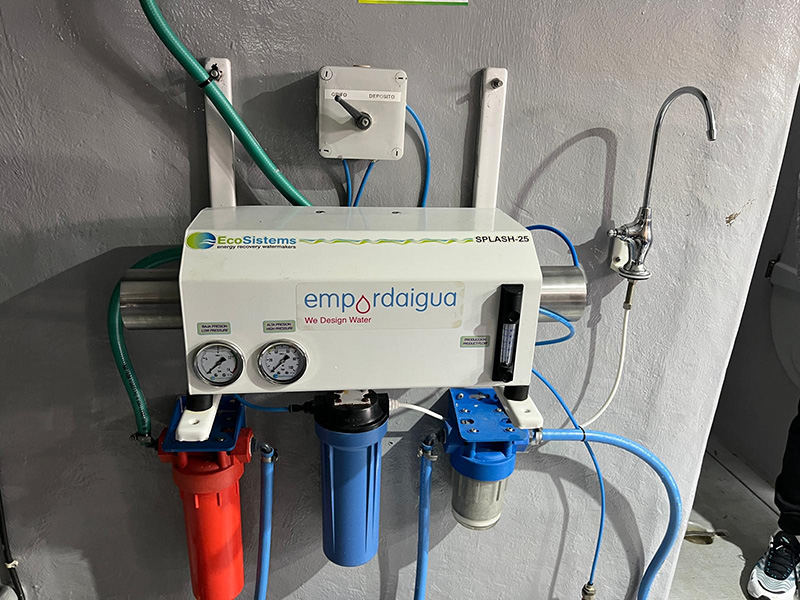
During a visit on Monday, 16 March, to the vessel Medan at the port of Roses, the Barcelona Provincial Council’s Deputy for Climate Action and Energy Transition, Marc Serra, pointed out that “this pilot project is cutting-edge because it helps us save thousands of litres of water, but also allows us to be more energy efficient, reduce emissions and avoid the use of single‑use plastic containers.” Serra added that “with desalination units on board, we provide vessels with greater autonomy, increased safety for the crew and more efficient operations. We want this to become a replicable option throughout our territory.”
The Catalan Government’s Director General for Climate Change and Environmental Quality, Sonsoles Letang, explained that “this initiative is an example of how the Climate Fund becomes a key tool for promoting transformative projects that make our economy more resilient.” She also highlighted that “adapting the fishing sector to rising temperatures is vital, and technological solutions such as these allow us to address the climate risks identified in our vulnerability assessments.”
Involvement of the fishing sector
During the visit, the President of the Catalan Federation of Fishermen’s Guilds, Antoni Abad, noted that “Catalan fisheries are implementing actions aimed at strengthening the safety and resilience of their operational processes, with initiatives focused above all on adopting more sustainable and efficient practices. With this commitment, the fishing sector is taking a step forward to ensure a safer activity, prepared for future challenges such as those posed by eCOadapt50.”
As the driving partner of the initiative, the Local Fisheries Action Group (GALP) Costa Brava has carried out projects worth more than €250,000 to support the local economy. Examples include the improvement of water management in the fishermen’s guilds of Girona, the acquisition of a sensor to measure sea temperature, a study on filamentous algae, aquaculture and gastronomy workshops, the design and construction of a climate shelter in l’Estartit, and the study of fregall in artisanal fishing grounds, among others.
Also within the framework of the project, the Institute of Marine Sciences (ICM – CSIC) has produced the document “Effects of Climate Change on the Catalan Fishing Sector”, which describes 12 climate change impacts that may be relevant for the fishing sector in a very clear and visual manner.