
Six Life eCOadapt50 partners take part in nine projects submitted to the Government of Catalonia to promote resilient agroforestry landscapes - Life eCOadapt50
Why are resilient agroforestry landscapes important?
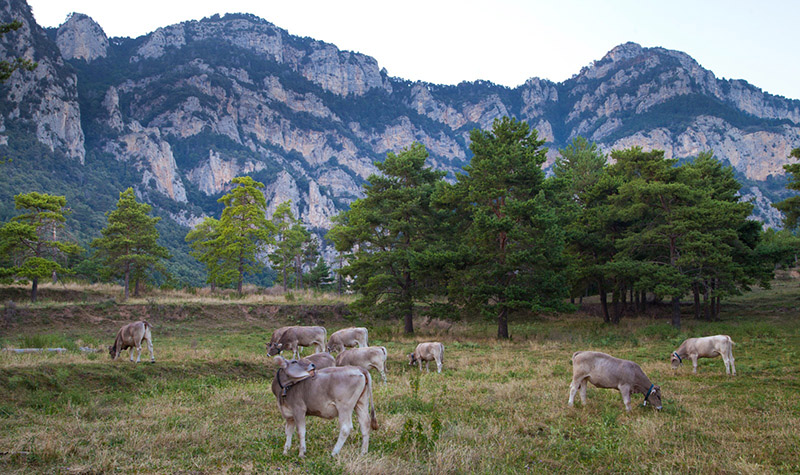
In Catalonia, socio‑economic and environmental changes are particularly intense and result in increasingly frequent challenges: droughts, forest vulnerability to wildfires, abandonment of farming and livestock activities, loss of biodiversity and habitat degradation. Restoring traditional mosaic landscapes and strengthening integrated land management is key to balancing environmental, social and economic dimensions. In this regard, the Resilient Agroforestry Landscapes programme promotes a concept of resilience that also includes the socio‑economic dimension and the capacity to maintain ecological functions and activity in changing contexts.
This programme derives from the Catalonia Bioeconomy Strategy 2030 (EBC2030) and is framed within RIS3CAT 2030, with the aim of promoting transformations that make the territory more resilient, innovative and sustainable. After an initial phase of territorial pilot projects, the programme is now rolling out a second phase through this grant call, aimed at scaling up initiatives across the country.
What do the DARPA grants consist of?
The Resilient Agroforestry Landscapes project grants are competitive subsidies designed to promote collaborative projects between local stakeholders and public administrations, with a strategic approach that integrates economic, social and environmental dimensions. The call places strong emphasis on building trust‑based networks, governance mechanisms and co‑creation processes to identify shared challenges and define long‑term actions, while also promoting bioeconomy‑related economic activity and efficient management of natural resources.
Among the main requirements, beneficiary entities must set up an Activation Committee (between 4 and 7 entities) and sign a collaboration agreement, designating one lead applicant entity. In addition, projects must be developed in an agroforestry territory with a continuous matrix of at least 5,000 hectares and include two or more rural municipalities. The application period for the 2026–2028 call ran from 17 January to 16 April 2026 (with an extension compared to a previous deadline).
What is the link between this call and Life eCOadapt50?
Life eCOadapt50 aims to promote climate change adaptation in vulnerable territories and sectors through diagnosis, participatory governance, action plans and demonstration measures. The resilient agroforestry landscapes call fits particularly well with this approach because it prioritises collaboration between local stakeholders and public administrations, the construction of a stable territorial governance framework, and the promotion of initiatives that improve the long‑term resilience of the agroforestry mosaic.
The Barcelona Provincial Council (DIBA), as the coordinating entity of Life eCOadapt50, has closely followed this process and supported participating partners when needed. This coordination is relevant because the resilient landscapes programme is aligned with country‑level strategies, including ESCACC30, and promotes governance and co‑creation mechanisms that are consistent with the working model that eCOadapt50 deploys in territories through its LL4CCs.
One of the key contributions of this call is that it provides resources to territories so they can organise themselves, cooperate and promote landscape‑scale initiatives. This can help overcome common adaptation barriers such as fragmented actions, lack of coordination or difficulties in mobilising funding. In this sense, the participation of Life eCOadapt50 partners strengthens the project’s capacity to connect demonstration measures and learning processes with external instruments that can support the scalability and continuity of adaptation actions.
As the results of the call become available, Life eCOadapt50 will continue working to foster synergies, share lessons learned and promote adaptation based on governance, knowledge and action on the ground.