
The Diputació de Barcelona hosts a key technical meeting of the Life eCOadapt50 project on public policies, business engagement and financing for climate adaptation - Life eCOadapt50
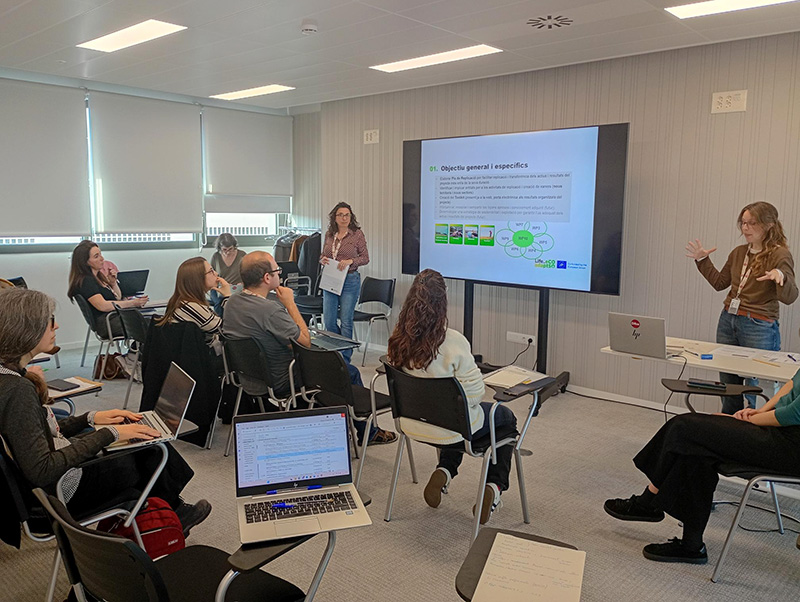
The session began at 11 a.m. with a welcome and an initial round of introductions, followed by an in‑depth discussion on the objectives of WP7 towards the 2030 horizon. The Diputació de Girona, represented by technician Judit Vilà, presented the outcomes of the session held at CONAMA Local on 2 December, as well as the tasks foreseen in the grant agreement. Based on this introduction, participants reflected on which areas of local and supralocal administrations are most strategic for incorporating climate change adaptation and which instruments could facilitate this. A specific debate was also opened on the role of businesses, aiming to identify pathways for the private sector to integrate adaptation criteria into their planning and business models.
Before the break, the Diputació de Tarragona, represented by technicians Gemma Pepió and Caridad Gil, presented the objectives of WP10, a work package that begins this year and will be essential to ensure the project’s replicability and sustainability beyond its execution period.
The second half of the technical session focused entirely on WP8, which addresses climate adaptation financing and is led by the Diputació de Barcelona. Javier Gómez, from ARÇ Cooperativa, presented a proposal centered on risk management and the role of insurance as a tool to tackle climate‑change impacts in territories. Afterwards, Marina Clarà, technician at the Oficina Catalana del Canvi Climàtic of the Generalitat, presented a report elaborated jointly with the Diputació de Barcelona on public and private financing options for adaptation actions. She also outlined a forthcoming tool being developed within the project to help identify funding sources and opportunities for adaptation measures at local and supralocal levels.
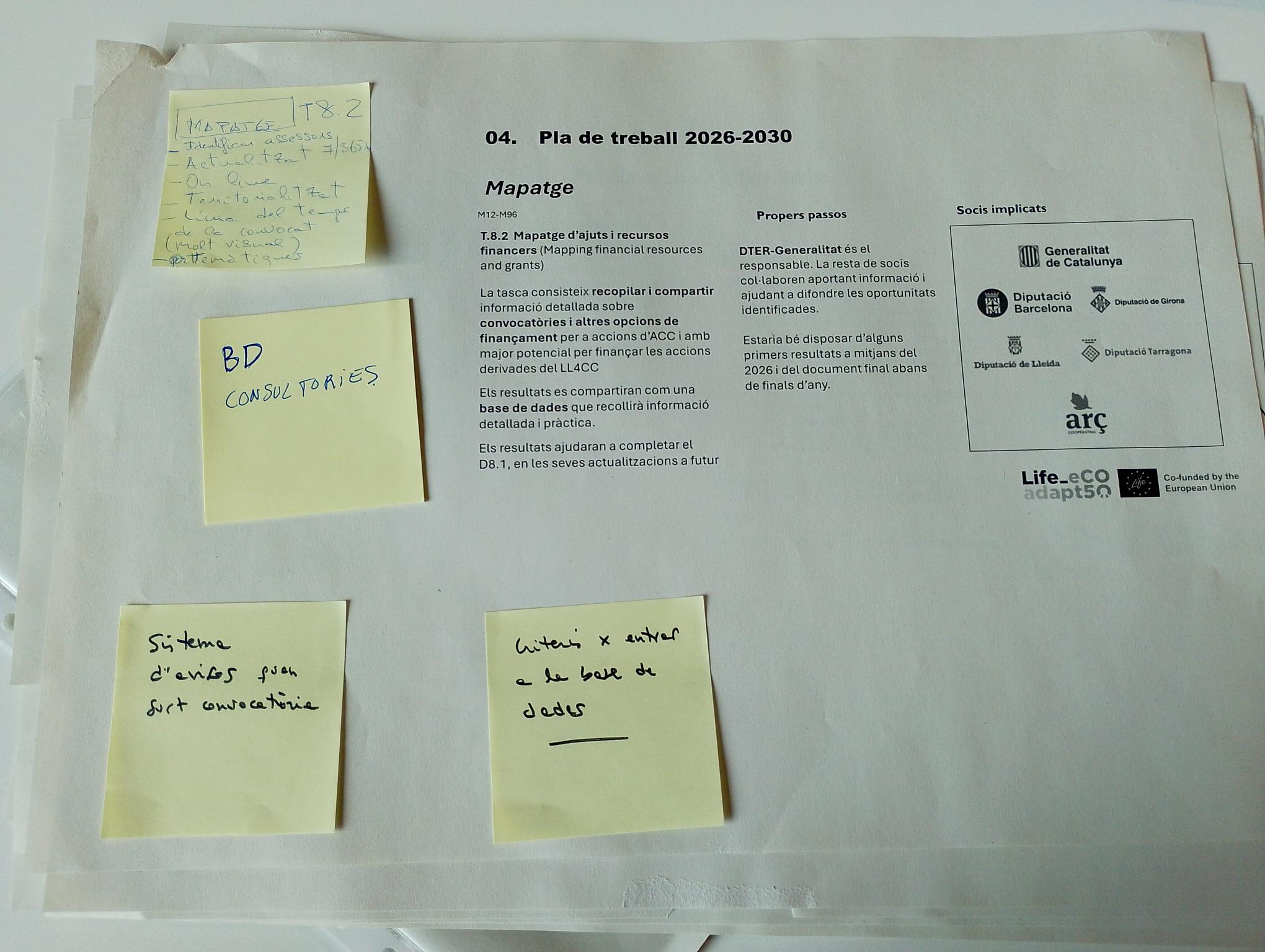
The event concluded with a participatory activity organized by the Diputació de Barcelona, where participants contributed ideas for the 2026–2030 work plan. The proposals emphasized future exchange platforms, new financing instruments, aid mapping, and the role of insurance in climate‑risk management.
The meeting ended at 2 p.m., giving attendees the chance to continue exchanging views informally over a small reception. The session once again demonstrated the strong commitment and involvement of the project partners in advancing towards more robust, integrated and coordinated climate adaptation across the territory.