
Extensive livestock farming management with GPS collars – Virtual fencing - Life eCOadapt50
| Start date | 11/03/2024 |
| Sector | Agricultural, livestock and forestry sector |
| Lead partner | Unió de Pagesos de Catalunya |
| Area of operation | Sant Feliu de Pallerols (La Garrotxa) |
| Climate risk | Decrease in the production of crops and livestock farming |
| Budget | 32.831,05 € |
Preservation of biodiversity, one of the benefits of extensive livestock farming
There is widespread consensus on the benefits of extensive livestock farming, both from the socioeconomic point of view, due to the fact of settling in rural areas, and from the environmental point of view, due to the ecosystem services it provides.
Promoting this type of livestock farming avoids the abandonment of livestock farming and the management of meadows for mowing and crops in mountain areas, thus avoiding the increase of forest area due to the increase of the area of underbrush and forest and, as a result, the loss of biodiversity of these environments since a wide variety of fauna (birds, mammals and insects) and flora is adapted to living in these open areas.
Herd control during grazing season, one of the most labour-intensive tasks
However, economic profitability is a limiting factor when it comes to maintaining these herds, and one of the most labour-intensive tasks in extensive livestock farming is herd control during grazing season, as it can cover a very large area and, in some cases, difficult to access, meaning that locating the livestock requires time and resources that cannot be devoted to other tasks on the farm.
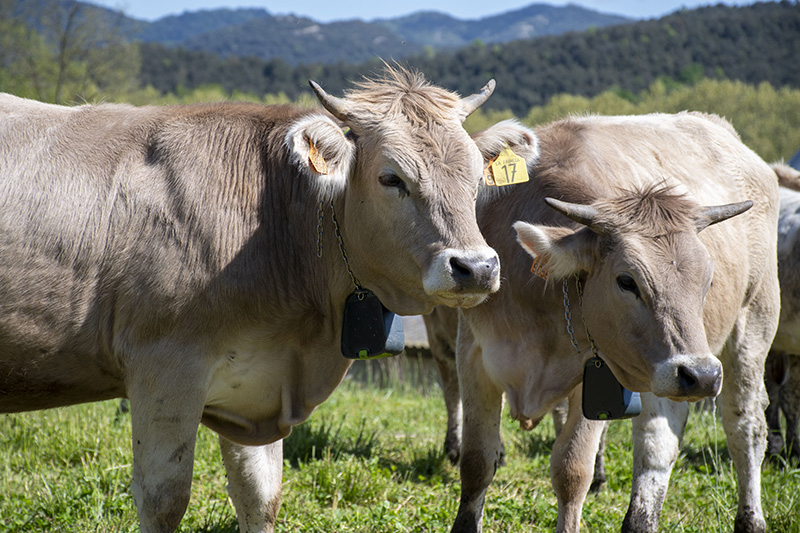
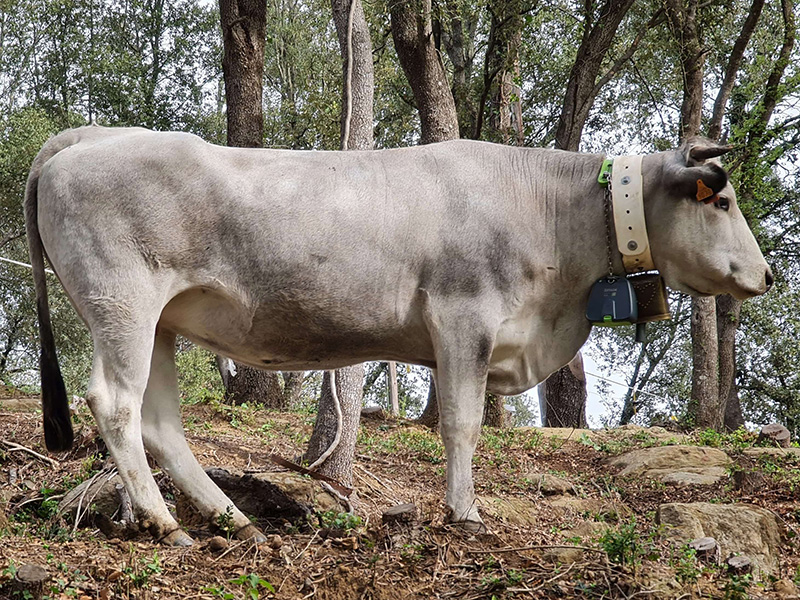
For this reason, Unió de Pagesos de Catalunya has promoted this pilot test focused on the use of collars with GPS geolocalisation which, through an application, enable you to create virtual fencing instead of traditional fencing in order to control herds, in this case herds of cows, and assess whether this technology can reduce livestock farming costs and whether it is replicable to other territories.
In addition, GPS collars can also be used to divide grazing areas into smaller plots, allowing for accurate monitoring of phenological status to determine the optimal time for livestock to enter and feed, promoting soil fertility and better use of grazing areas.
The risk of forest fires is one of the main climate risks in this territory
This action, with a budget of 32,831.05€ and an approximate duration of 36-48 months from March 2024 onwards, is inspired in a previous experience of this entity carried out between 2019 and 2021, takes place in the municipality of Sant Feliu de Pallerols, within the territory of the Associació per al Desenvolupament Rural Integral de la Zona Nord-Oriental de Catalunya (Association for the Comprehensive Rural Development of the North-Eastern Region of Catalonia).
Furthermore, apart from improving the competitiveness of livestock farms and, therefore, securing or creating jobs in sparsely populated areas, the action also aims to contribute to reducing the risk of forest fires and combating the decline in crop and grazing production, two of the climate risks identified in the territory.