
Regenerative livestock farming in Ripollès - Life eCOadapt50
| Date of onset | 23/07/2024 |
| Sector | Agricultural, livestock and forestry sector |
| Lead partner | Associació Leader Ripollès Ges Bisaura |
| Territory of performance | Sant Pau de Segúries (Ripollès) |
| Climatic risk | Loss of ecological balance Biodiversity loss |
| Budget | 15.000,00 € |
Imitate nature to increase soil fertility
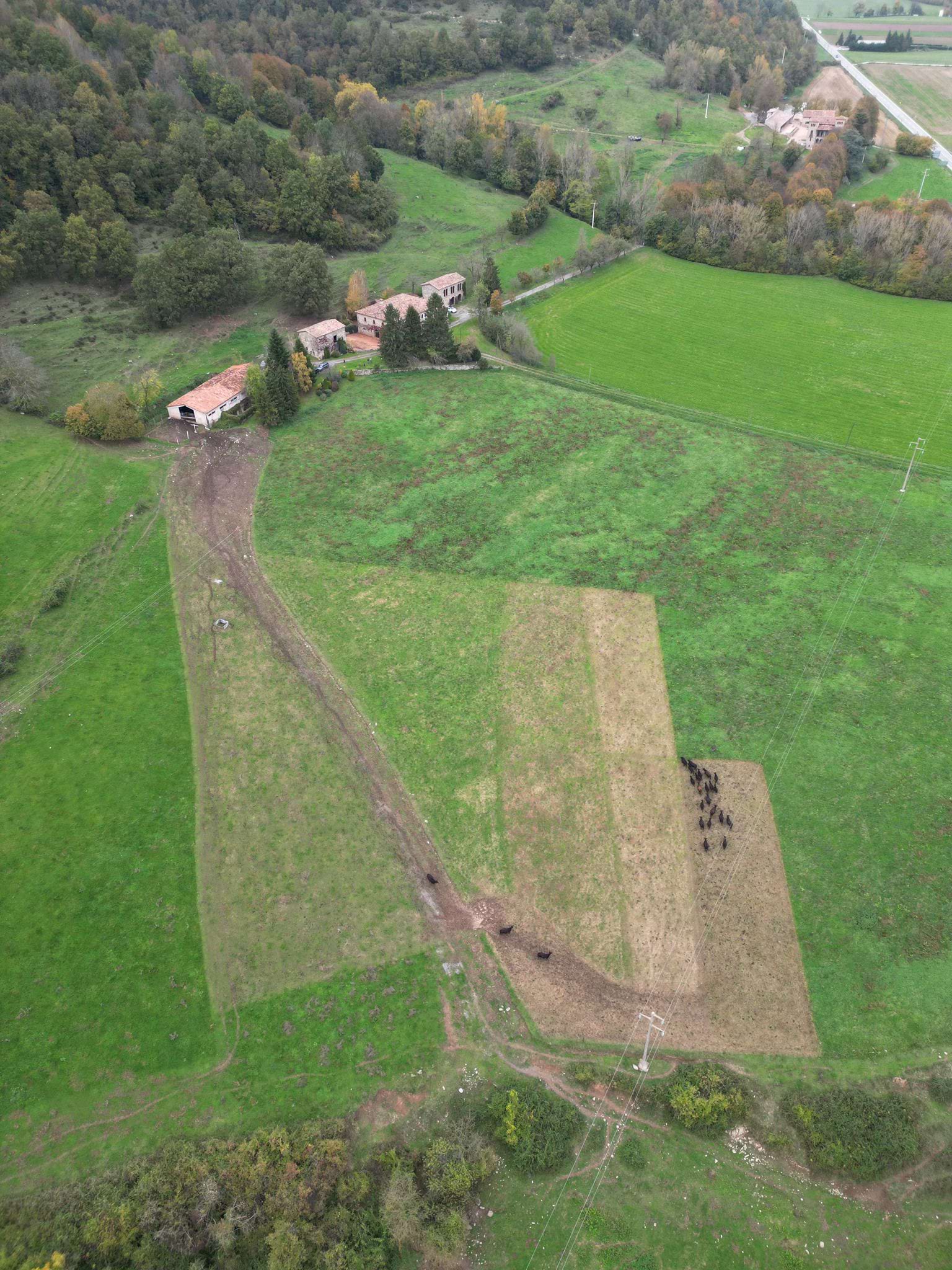
A regenerative agricultural and livestock system integrates living soil, plants and animals in a productive manner, mutually beneficial and interrelated. Understanding and enhancing the relationships between all these kingdoms allows us to imitate nature in order to increase fertility and profitability of the entire system, year after year. (Associació Agricultura Regenerativa Ibérica)
Thus, this productive model, tries to develop nature’s own processes to regenerate itself, avoiding the use of agrotoxins and chemical products, in addition to create local and resilient economies.
Towards a more sustainable livestock at Mas la Sala
However, implementing this model also requires a series of human resources and materials, in particular staff dedication to monitor and analyse soil evolution data and physical and productive conditions of livestock, and the installation of drinking troughs in each plot under the corresponding hydrological design.
The action implements in properties of Cooperativa Mas la Sala, located in the municipality of Sant Pau de Segúries and on an area of approximately 100 hectares, where the test is divided in two big groups: sheep and cows.
Pioneer experience in Catalonia
The fact that this regenerative livestock model is implemented in an entire property is a pioneer experience in Catalonia, but it has the support of Associació d’Agricultura Regenerativa Ibèrica (AR) and Xarxa d’Economia Solidària de Catalunya and will enable us to assess how it contributes both to the improvement of quality and to a series of ecosystem impacts such as forest fire prevention, the creation of habitat for the biodiversity of the area, the environmental improvement in the very reduced use of oil in the entire production process or the valuation of local species or varieties that have more capacity to adapt to the new climate conditions.