
First joint meeting of the 16 Living Labs of the Life eCOadapt50 project in Vila-seca to learn co-creation tools and define actions - Life eCOadapt50
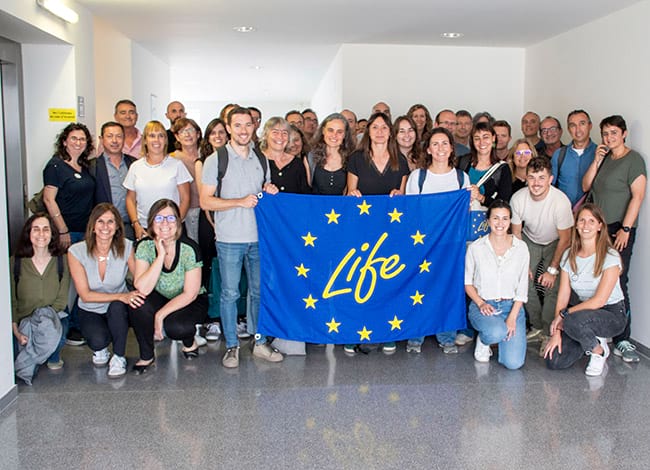
These participatory spaces were established at the end of 2023 and involve public administrations, economic sectors, organizations, and citizens to define strategies and actions to increase local resilience. The initial meetings have already engaged over 415 local stakeholders.
During the first half of 2024, the Living Labs reconvened to identify climate risks and vulnerabilities in their territories. With support from the Institut Cerdà and oversight from the Catalan Office for Climate Change, this work will result in a climate vulnerability diagnosis for each territory. The adaptation actions to be implemented will align with these findings.
In the second half of 2024, the first demonstrative climate adaptation actions are expected to be launched in the project’s territories.
The Barcelona Chamber of Commerce has also designed a training plan to equip stakeholders with the knowledge needed to propose and select the most appropriate actions. Topics of greatest interest include water management, adaptation strategies, nature-based solutions, and sustainable management techniques.
The event began with a welcome from Juan Antonio Duro, Vice-Rector of URV; Òscar Saladié, Dean of the Faculty; Enric Aguilar, Director of IU-RESCAT; and Núria Parpal, Director of Life eCOadapt50. Ferran Bertomeu, a technician from Eurecat, gave a keynote on the definition and value of Living Labs, emphasizing their participatory nature and the importance of involving the quintuple helix (public administration, businesses, civil society, academia, and the environment) to foster innovation and sustainable development.
Following this, the IU-RESCAT technical team—Anna Boqué, Jon Olano, and Caterina Cimolai—led two group dynamics using co-creation methodology. The first focused on analyzing the current status of the Living Labs, while the second introduced tools for co-creating climate adaptation measures that can be applied in future local meetings.
To close the session, Antoni Domènech, lecturer at URV, moderated a debate on the composition and role of the Technical Advisory Council, a scientific-technical body that will support the Labs in defining, evaluating, and prioritizing adaptation actions. Several proposals emerged to help finalize the structure of this council, which is expected to become operational in the coming months.
The event concluded with remarks from Núria Parpal, who also announced that the Barcelona Provincial Council has contracted the Decidim platform to facilitate the management and organization of information and participatory processes related to the project and its Living Labs.