
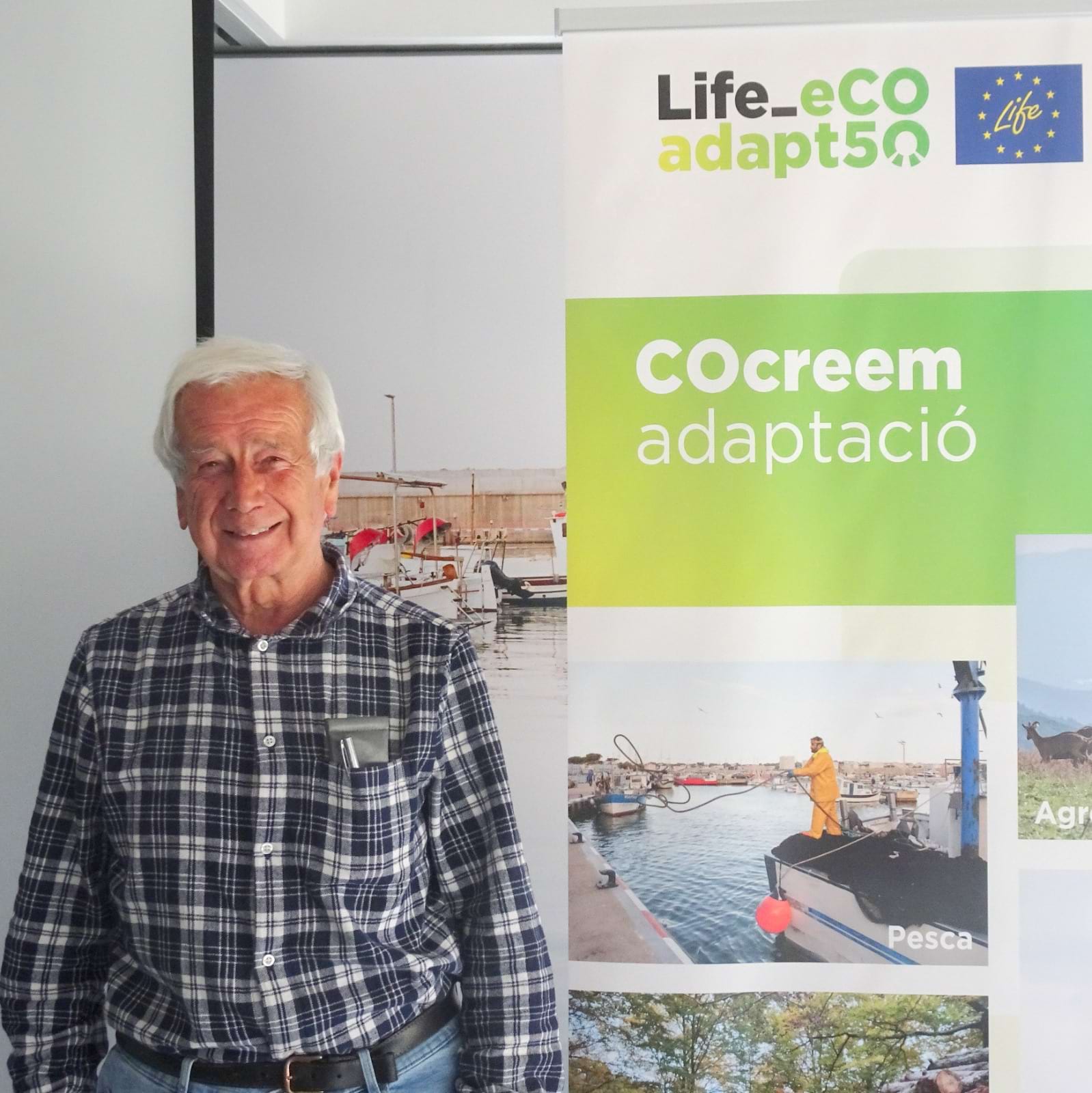
Acquisition of a sensor so that Josep Pasqual can continue measuring sea temperature and sea level - Life eCOadapt50
| Date of onset | 09/07/2024 |
| Sector | Fisheries and tourism |
| Lead partner | GALP Costa Brava |
| Territory of performance | Badia de Pals and les Illes Medes (Baix Empordà) |
| Climatic risk | Increase in eutrophication episodes |
| Budget | 15.000,00 € |
The sea surface temperature in l’Estartit, one degree warmer than 4 decades ago
Josep Pascual Massaguer has the longest sea water temperature data record in the Mediterranean. Towards 1969 he began taking meteorological measurements and in 1974 ventured out to sea. In the late 1980s he began to notice changes in the data. Since then, sea temperatures have been increasingly rising. According to Pascual’s figures, the sea surface temperature has risen to one degree above normal.
Overall, Pascual’s data reveals that the sea temperature in l’Estartit has risen from an annual average of16 o r16.5 °C to the current 17.5 °C. At a depth of 90 metres, the increase has been half a degree. The highest temperatures are reached at the sea surface in summer. Previously, the average summer temperature was around 22 or 23 °C, but in recent years the figures have risen de 24 or 25 °C. In August 2022, the heat record since Pascual began collecting data was beaten: sea water reached 27.5 °C. “The situation is serious”, he claims, and estimates that by the middle of this century, the Catalan coast could reach 30 °C.
15 metres less of beach in 30 years
Since 1993, Pascual also measures beach erosion. In this case, he does so from the top of the Rocamaura hill, a 225-metre-high mountain from which you can see the entire bay of Pals and beyond until Begur capeI. In this regard, observations indicate that half a metre of beach is lost every year, and in just over 30 years the nine kilometres of beaches in this area of the Costa Brava have receded a total of 15 metres.
Action to ensure the continuity of data record
Having this data is essential when creating adaptation actions to climate change. That is why, with the aim of ensuring the continuity of this pioneering reference data series, there are plans to acquire a new probe to measure the conductivity, temperature, pressure and turbidity of the water. This acquisition will be accompanied by a series of communication capsules with the aim of disseminating, raising awareness and transferring this knowledge.